

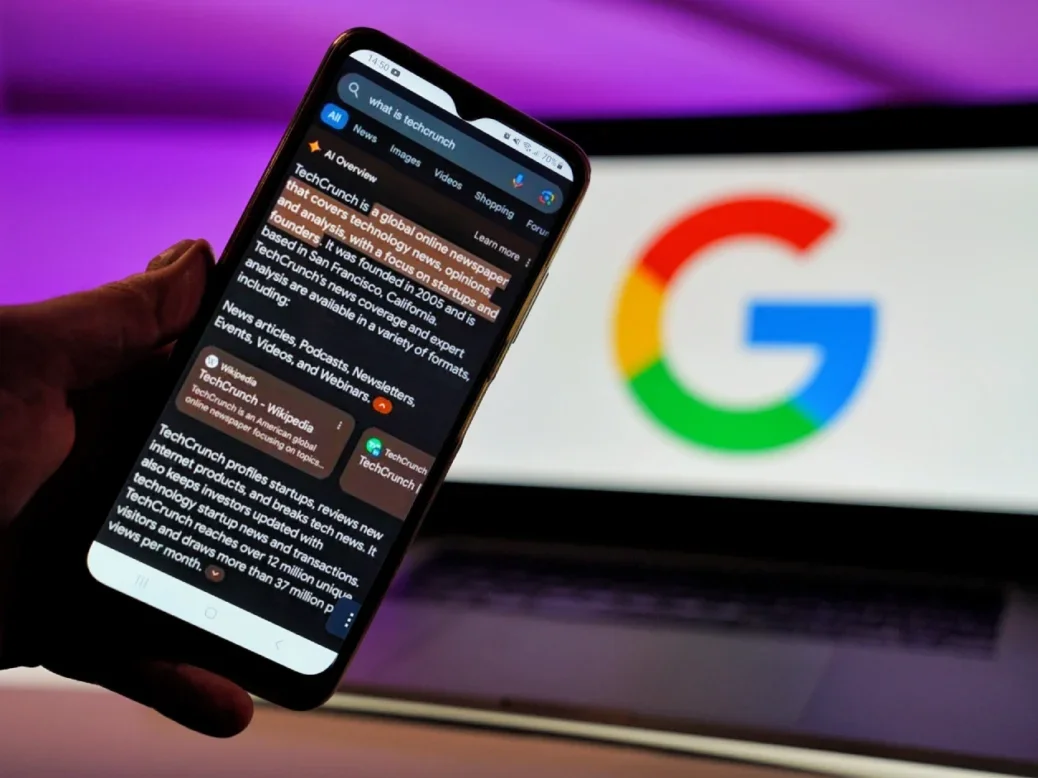
In a world first, UK regulators today told Google to give publishers control over how their content is surfaced in AI answers.
In response Google announced that (from today) it will test “a new control that lets website owners manage how their links and content appear in generative AI Search features”.
The Competition and Markets Authority ruling tackles a number of longstanding complaints from publishers over lack of transparency and control over how their content is surfaced by Google.
So far, Google has made it impossible for publishers to remove their content from its AI-written answers without also removing themselves from Google’s main search index (the way most people in the UK access the internet).
Yet the introduction of AI-written Google summaries has led to plunging Google referral traffic and a rise in zero-click searches as they remove the need for readers to click through to an article source.
The CMA said Google must do the following:
“– provide publishers with effective controls over the use of their search content in generative AI
“– publish clear, comprehensible and user-friendly information explaining how publishers’ search content is used by Google in its generative AI
“– provide publishers with clear and detailed metrics on user engagement with their search content in search generative AI features
“– take reasonable steps to ensure that search content is attributed clearly and accurately in general search, and that end users have a clear means to access that search content
“– publish clear, comprehensible and user-friendly information explaining its approach to attribution.”
The CMA said: “Publishers will now have effective tools to prevent their content being used to power AI features in search, such as AI Overviews. This will put publishers, like news organisations, in a stronger position to negotiate content deals with Google.
“To boost consumer trust, Google is also now required to make sure that publisher content is properly attributed, using clear links, in AI‑generated search results.
“Following consultation feedback, Google will now also have to allow publishers to opt out of allowing their content to be used for the ‘fine-tuning’ of AI models. This provides publishers with confidence that they will have control over the full range of AI use cases of their content.”
Chief executive of the CMA Sarah Cardell said: “With features like AI Overviews rapidly reshaping online search, it is crucial that content publishers, including news organisations, have appropriate bargaining power over how their content is used. At the same time, these measures will help tens of millions of UK search users better understand and trust the information presented to them.
“It’s also important that any action we take in this space can move with the times. Google has recently announced changes to its search business and the requirements we’ve introduced today are designed to respond to what Google is doing now and in the future. We’ll also continue to use the unique flexibility of the UK regime to monitor and address future concerns as they arise and we will be announcing further action in relation to Google’s search business in the coming weeks.”
Google’s response to CMA ruling
Google issued a blog post timed to coincide with the CMA announcement saying “features like AI Overviews and AI Mode are designed to help people find and visit great websites”.
And it said: “We’ve increased the number of inline links directly within responses and added helpful website previews to encourage people to click through.
“We recently brought Preferred Sources into AI Overviews and AI Mode and launched new subscription labels in these features, so people can choose the websites that they want to see more prominently.
“Looking ahead, we’re continuing to experiment with a range of new link designs in our AI experiences to make them more useful.
It also said: “We’ve shared updated guidance to help website owners improve the visibility of their sites in generative AI Search features. This includes tips on the importance of providing unique, non-commodity content for readers, and information for websites about how to organize their content, create a good page experience and provide high quality images and video to enhance their pages.”
Google to roll out new AI controls for publishers globally
And it said (from today) publishers can manage how their links appear in AI-driven search.
“With this new toggle in Search Console, website owners can decide if they want their site to appear in and help ground responses in our generative AI Search features (like AI Overviews, AI Mode or AI Overviews in Discover). Sites that opt out will not receive traffic or impressions from our generative AI features. This control will not be used as a ranking signal for search results outside of these generative AI Search features. This work builds on our long history of designing tools, like snippet controls and Google-Extended, that give websites more choice.”
It added: “We’re also starting to roll out new insights for website owners in Search Console about the appearance of their pages in generative AI Search features. These insights include impressions metrics and information about which pages appear in AI responses and in what countries. We’re continuing to work with website owners to understand what insights will be most helpful to inform their strategies, and we’ll introduce additional metrics over time.
“We are beginning to roll these features out to a subset of website owners in the UK, allowing for thorough testing before rolling them out to website owners globally. As AI opens up new opportunities for discovery, we’ll keep improving our experiences to help people explore the web, and keep building tools for websites to better engage their audiences.”
Publishers cautiously welcome CMA move
CEO of the News Media Association (the trade body for UK national and regional newspapers) Theo Bamber said: “UK news publishers produce some of the most valuable content in the world, but until now dominant platforms like Google have been allowed to dictate the terms of how that content is used.
“The legally enforceable Conduct Requirements for Google Search published today are a significant step towards levelling the playing field and building a fair, transparent digital economy where premium content is properly respected and fairly compensated.”
Financial Times chief executive Jon Slade said: “Obviously greater control and transparency for publishers must be a good thing, and I look forward to seeing how these changes play out in practice as we navigate this sea change in the information ecosystem.”
Paul Deegan, who is CEO of trade body News Media Canada, supported the action taken in the UK. He said: “This is a very welcome announcement by the CMA. The UK has shown the world the way. Without a realistic opt out publishers everywhere have been held ransom by Google.
“We will encourage our government to force an opt out. We need to create scarcity and friction to force Big Tech to the compensation negotiating table. Our IP must be protected.”
CEO of the Professional Publishers Association Sajeeda Merali said: “While it is positive that publishers will be able to opt out of having their content used to fine-tune Google’s AI models, it is disappointing that the control will not be per-feature or per-purpose. Publishers will have to decide whether their content will be on all search AI features or none of them and if they decide to allow Google to train on their content, then there is no way of opting out specifically of grounding.
“Publishers need to understand not only when their content is being used, but also how it is being used. They should have a genuine choice over whether their content is available on different AI search products, particularly when those responses may reduce the incentive for users to visit the original source.”
Jason Kint, CEO of US trade body Digital Content Next, said: “It’s good work by the CMA to enable greater publisher control and attempt to deal with Google’s monopoly leverage from search. But copyright is not an opt-out regime – it’s opt-in.
“Publishers shouldn’t have to wait weeks or months to exercise rights they already have. And this still does nothing to address the vast amount of protected content already forcefully taken and used to train AI models without permission or compensation.”
Stuart Forrest, who until recently was global audience development director at Bauer, wrote on Linkedin: “Google announced new AI reporting in Search Console. It’s rolling out sporadically, covers impressions only, and carries no guarantee of access for all site owners. That’s not enough information to make a real decision on AIO’s value.”
He added that new controls for publishers are not a “breakthrough” because “framework is opt-out, not opt-in”.
Forrest continued: “Those two gaps compound each other. Publishers need transparency and genuine control and an opt-in architecture, not the reverse. Without real data and a real choice, there’s no basis for the value decision publishers need to make on AIO. And the commercial inertia of staying in when most competitors won’t opt out means that, in practice, almost no-one will exercise the control CMA is calling a victory.”
Why has Google been given nine months to comply?
Co-founder of the Movement for an Open Web Tim Cowan welcomed CMA action but said the regulator was being for too slow.
“MOW welcomes the CMA’s response to the formal complaint we filed nearly a year ago alongside the Independent Publishers Alliance and Foxglove that Google was taking publisher content without permission or payment. The imposition of conduct requirements and allowing publishers to opt out of Google’s use for its AI are – in principle – a considerable improvement on previous proposals, but in practice we fear they will be ineffective.
“We are disappointed that the obligations will come into effect only in six months, rather than immediately as in previous cases, and Google will then have nine months to implement, subject to a six-monthly review by way of monitoring thereafter, but for the first year only. This means that a harm that started over three years ago and has been allowed to go unremedied will continue to be unremedied for another nine months – and we will not know whether compliance has been effective until late 2027. This is not an effective remedy nor, given Google’s history of non-compliance with remedies in other cases, is it likely to be effective in practice.
“The CMA has also indicated that it is willing to accept Google’s promises of compliance with no firm baseline, which was requested by many publishers. It refers, for example to ‘periodic compliance reporting’ but not whether the time period for each report is daily, weekly, or monthly.
“The CMA’s decision here considers the compliance burden on Google to be more significant than the continuing harm to publishers. This is a serious failure to understand the level of peril facing publishers who have seen their traffic and incomes severely reduced.
“We are also concerned that the CMA’s approach to speed of enforcement and oversight is getting longer. In our Privacy Sandbox case the CMA imposed quarterly reporting obligations. Here, the reporting requirements are set at six-month intervals meaning that it’ll be six months before we know if Google is complying and then a further six months before we’ll know if any additional remedies have worked. In a year the majority of independent publishers could be gone. Regulation needs to move at the speed of digital and this decision is not fit for purpose.
“The CMA’s obligations do offer publishers a way forward but only if they deal with enforcement themselves.”
Under the Digital Markets, Competition and Consumers Act Google can be fined up to 10% of its annual turnover (more than $40bn, or £30bn) if it is found to abuse its dominant market status.
Meanwhile, the CMA is also conducting strategic market investigations into Apple and Microsoft.
According to Press Gazette analysis, Google accounted for around £21.5bn out of total UK adspend of £46.7bn last year (compared with £1.6bn spent with every UK newspaper and magazine publisher combined).
Email pged@pressgazette.co.uk to point out mistakes, provide story tips or send in a letter for publication on our "Letters Page" blog
